
Therma
Find nearby places with the weather you want.
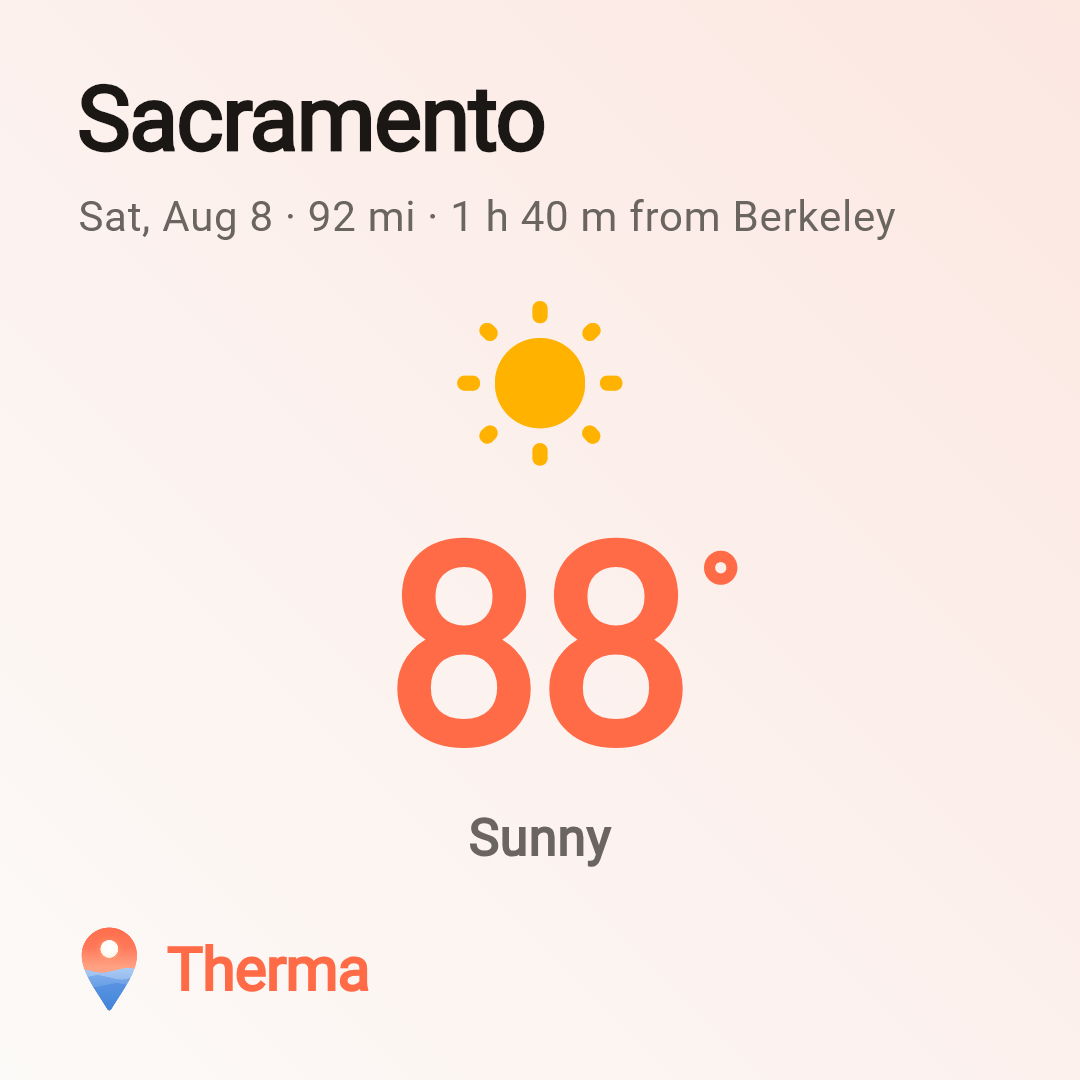
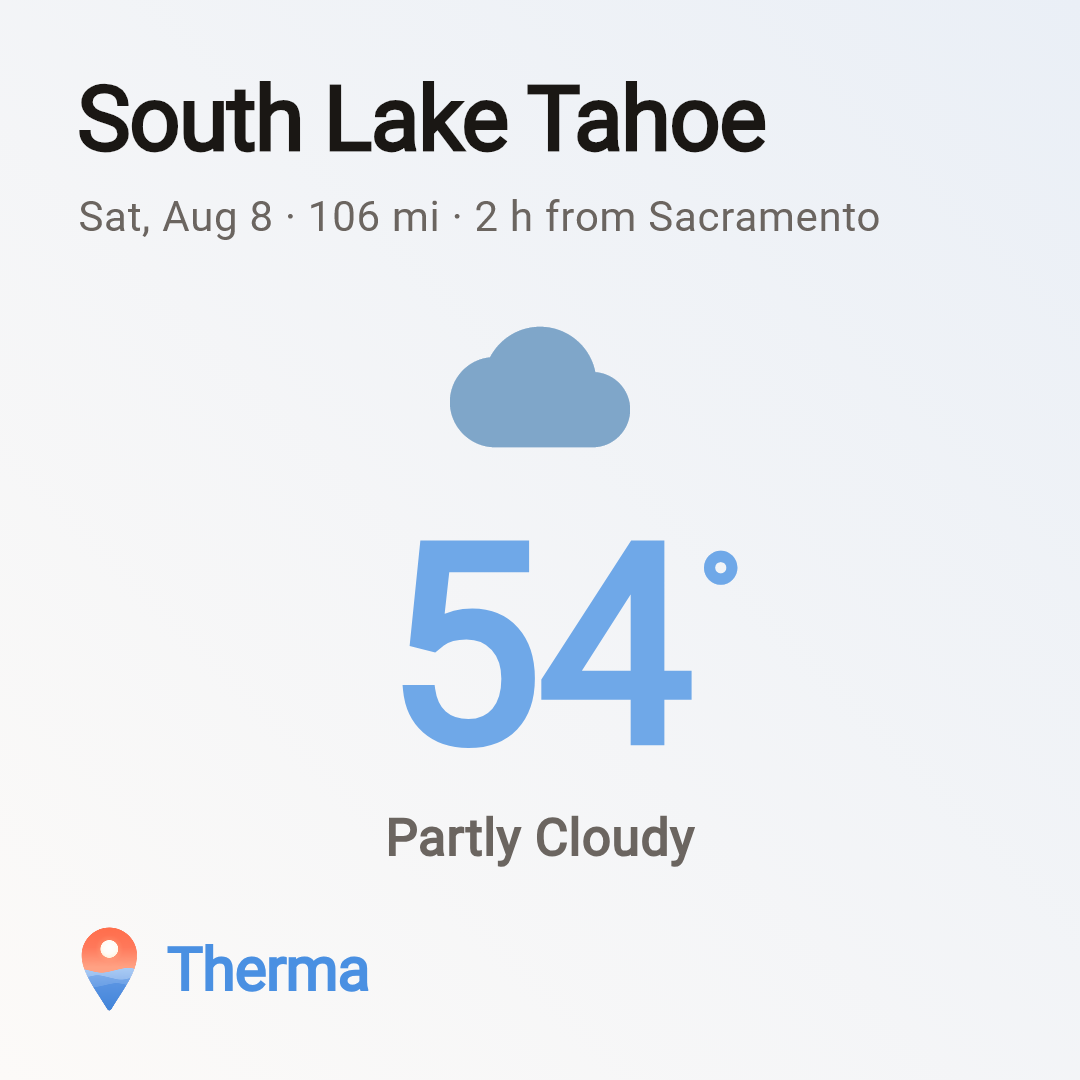
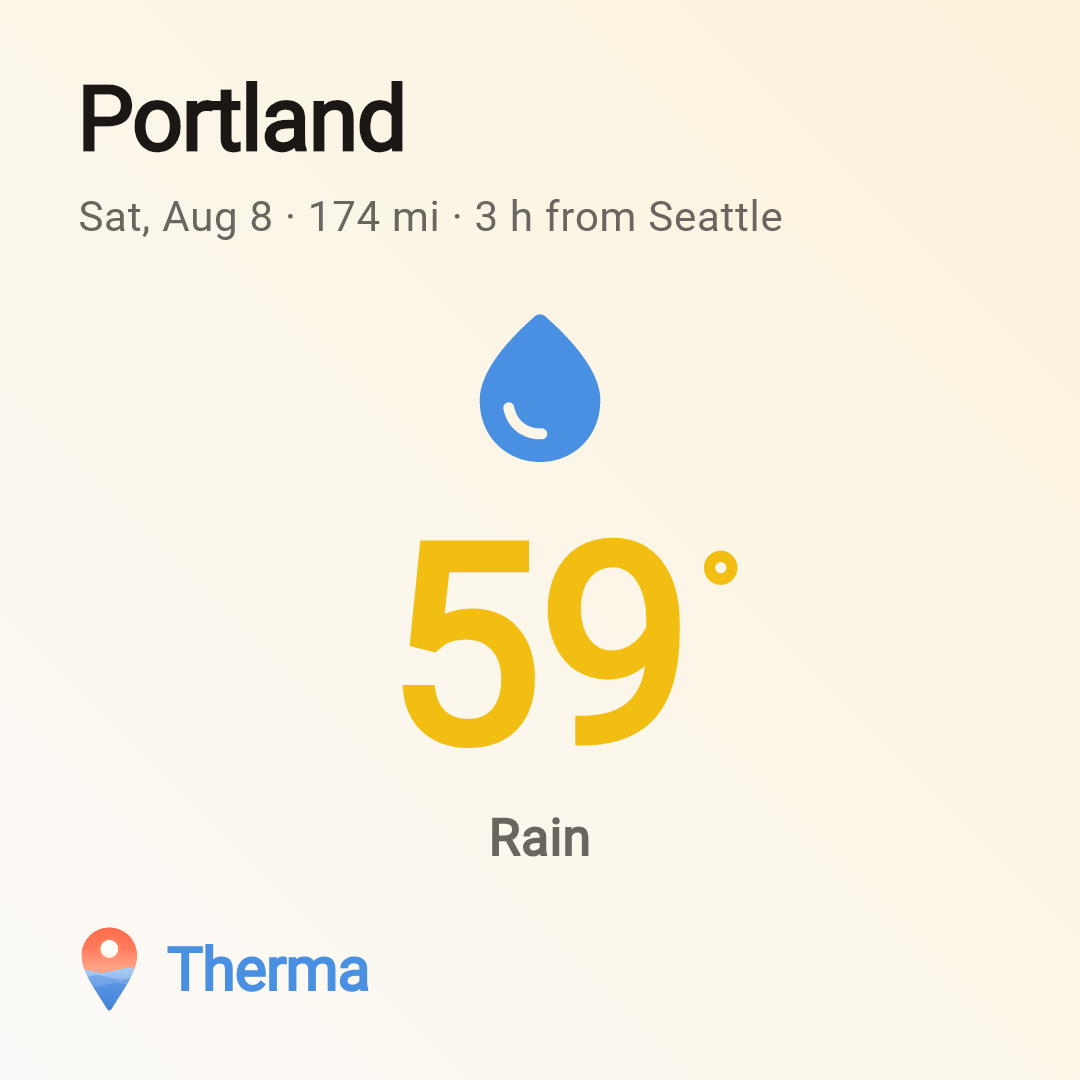
Choose where you start, how far you’ll drive, a day in the coming week, and whether you want it warmer or cooler. Therma lists up to ten places whose forecast is noticeably better than home’s, with drive times and directions.
- Platform
- iPhone & Android
- Status
- Pre-launch testing
- Started
- May 2026
- Stack
- Flutter · Supabase · Postgres
The problem
Where nearby is the weather better?
A weather app tells you what it will be like where you are. On a hot week or a grey weekend, the more useful question is where nearby it will be nicer. Answering that today means checking forecast after forecast, town by town.
Therma answers it in one step, with a short list of real options, each with its forecast and drive time. To keep it focused, I left out a map view, accounts, ads and a paid tier at launch. Every result is a real forecast for the day you pick, and if you ask for warmer, every place on the list is warmer by a margin you would notice.
Architecture
What happens when you search
Therma is a Flutter app, a Supabase backend built on Postgres and Edge Functions, and an offline data pipeline. Weather and routing data cost money per request, location is sensitive, and the app runs on phones I don’t control. Those three facts shaped every step below.
When you search
-
You ask
Where you start, how far you’ll drive, the day, and warmer or cooler.
Therma app -
The request is checked
The session is verified, rate limits apply and the input is validated.
Edge Function -
Places in range
Every destination within your drive is found with one spatial query.
Postgres + PostGIS -
Forecasts gathered
Cached forecasts are used first. Only missing ones are fetched.
Cache, then weather API -
Results on your phone
The best matches are ranked, drive times are added for the shortlist, and the list comes back.
Edge Function → app
Ahead of time
Catalog pipeline
A Python pipeline builds the catalog of places offline. Claude writes each one’s short description.
Forecast warmer
A scheduled job keeps forecasts fresh in areas people are searching.
Principles behind it
- The app is untrustedIt holds only Supabase’s public key and can’t read any table. Every search goes through one Edge Function that checks the session, applies rate limits and validates the request.
- Spend where it countsForecasts are cached in Postgres and shared between searches. Drive times, the most expensive lookup, are fetched only for the final shortlist.
- Location stays privateThere are no accounts. A precise location is used for the search and then discarded. It is never stored or logged.
- Fail closedIf a safeguard can’t run, the search is refused rather than served without it.
- Heavy work happens offlineBuilding and describing tens of thousands of places happens once, ahead of time, so a search only has to look things up.
Building with AI
How AI was used
I built Therma with Claude Code as an engineering partner across the Flutter app, the Supabase backend, the data pipeline and the documentation. The code lives on GitHub, where CI runs the tests and a secret scan on every change.
Led by me
- The product question and its scope
- What to build and what to cut
- Design, brand and the app icon
- Judging results against real trips
- Approving every plan and change
Accelerated by AI
- Drafting plans and options for me to review
- Implementing across app, backend and pipeline
- Writing tests and catching regressions
- Structured QA and security reviews
- Keeping the docs in step with the code
How the work was run
- Plan firstEach phase started as a written plan with options and trade-offs. I reviewed and approved it before any code was written.
- Small, reviewed batchesWork landed in waves. Each was tested and checked on a live development environment before the next began.
- Root cause before fixQA passes produced bug trackers that recorded why something broke before a fix was proposed.
- A decisions logEvery significant choice is written down with its reason, so later work doesn’t undo it by accident.
- Docs change with the codeWhen behaviour changes, the page that describes it changes in the same pull request.
AI inside the product
Therma uses a model in one place. During the offline catalog build, Claude writes a short line about what each destination is known for, using only open reference material about that place. It runs once, in batch, and the results are stored. Nothing is generated while you search.
Ranking is plain, testable code. Choosing the better forecast is arithmetic, and it should be predictable.
Lessons
What I learned
- Cost shapes architectureKnowing what each API call costs shaped the design as much as any feature did.
- Process matters more with AIWritten plans and review gates are what make an AI agent productive. Without them, mistakes pile up as quickly as code does.
- Build privacy in earlyDeciding at the start not to have accounts removed a lot of work and risk.
- Finished means documentedKeeping docs current made every new pass faster, for me and for the AI working from them.
Progress
Where it stands
- First working version on a phone
- Feature set settled and structured QA passes begin
- Search rebuilt so every result is a real forecast
- Privacy, security and store-readiness work
- NextLaunch on iPhone and Android
Questions about Therma?
I’m happy to talk about the product, the design or how it was built.